
GST : 27AAFFV7667M1ZA

Call us
08045801431
Call us
08045801431

The 2026 EVA Shoe Mould market is becoming more specialized, driven by lightweight footwear, sports recovery products, and fast regional production. Grand View Research and Fortune Business Insights both identify footwear as a major application area for EVA materials, supported by demand for cushioning, flexibility, and lower shoe weight. However, material growth does not automatically guarantee better mould performance.
Global buyers must compare mould types against production volume, foam expansion, product geometry, and factory equipment. Compression moulds remain practical for slippers, sandals, and selected casual soles. Injection moulds support higher repeatability and complex athletic footwear designs. Dual-density and multi-color moulds can combine visual appeal with different cushioning zones. Some factories also use specialized Phylon moulds for lightweight midsoles, although process control can become demanding.
World Footwear’s annual industry reports show the continued scale and geographic diversity of global footwear manufacturing. Production may shift between Asia, Europe, Latin America, and emerging markets. Therefore, an EVA Shoe Mould should be evaluated beyond its purchase price. Steel selection, cavity balance, venting, cooling, surface texture, and replacement-part access affect long-term cost.
Small details matter.
A 0.3-millimeter mismatch can create trimming problems. Uneven vents may leave visible marks on a white midsole. These examples are practical, but not universal. Factory skill still changes the result. Buyers should request trial samples, dimensional records, foam-density data, and documented quality procedures before approving a supplier. This guide examines the leading EVA Shoe Mould types for 2026, while recognizing one uncomfortable fact: no mould design fits every material, machine, or market.
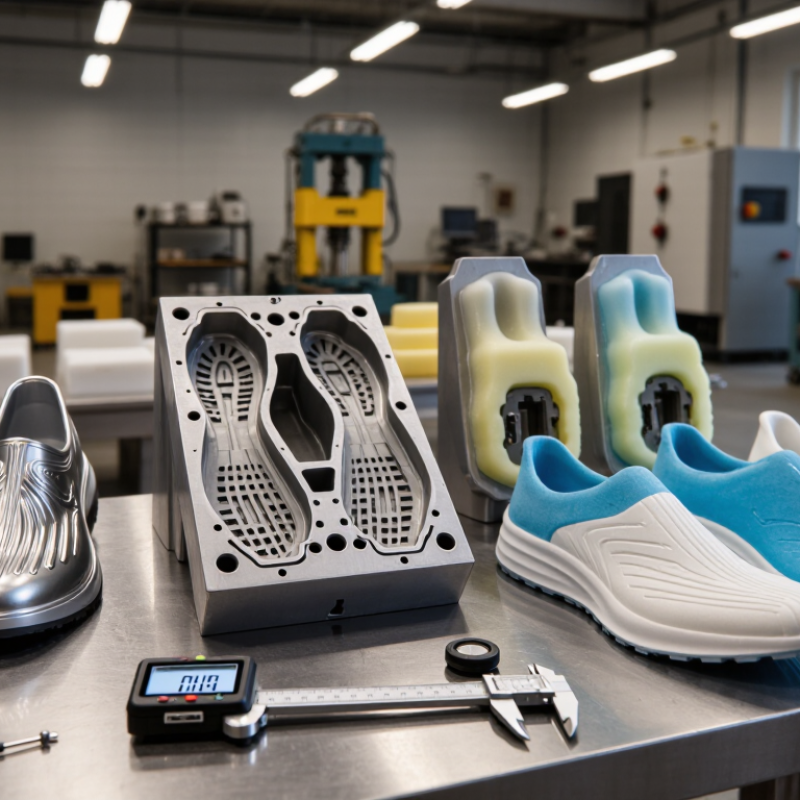
2026 Top EVA Shoe Mould Types for Global Buyers
EVA shoe moulds shape foam through heat, pressure, and controlled expansion. The main types are compression moulds and injection moulds. Compression moulding uses a measured EVA preform inside a heated cavity. Pressure then forces the material into the outsole pattern. Injection moulding feeds heated EVA directly into the cavity, supporting faster repeat production. The choice depends on volume, density, surface detail, and equipment capability.
World Footwear Yearbook 2023 recorded 23.9 billion pairs produced globally in 2022. Asia accounted for about 87.4% of that output. These figures explain the demand for stable mould cycles and consistent sizing. EVA pellets normally contain a foaming agent, crosslinking agent, and color additives. Heat activates the formulation. The material expands, bonds, and cools inside the mould. Small errors matter.
Cavity temperature, vent placement, and shrinkage allowance need practical testing. Aluminum moulds transfer heat quickly and suit many production runs. Steel inserts can improve wear resistance around sharp textures. A polished cavity may create a clean surface, while a textured cavity improves visual depth. Buyers should request trial data, not only drawings. A mould can look precise and still produce uneven density. That weakness is easy to miss. Measurements should include weight, hardness, expansion ratio, dimensional tolerance, and bonding performance. Test results sometimes disagree, so production conditions must be recorded honestly.
EVA mould selection now depends on volume, cushioning, and surface detail. The World Footwear Yearbook 2024 reported 23.9 billion pairs produced globally in 2023. Asia supplied about 88% of production. This scale increases demand for stable, repeatable mould systems.
Compression moulds remain practical for lightweight EVA soles and sandals. They suit medium production runs and allow flexible density control. Injection moulds support faster cycles and sharper patterns. They work well for high-volume footwear with consistent sizing. Direct-injection moulds can reduce handling between foaming and forming stages. Aluminum moulds offer faster heat transfer and lower tooling weight. Steel moulds usually provide stronger wear resistance, especially under continuous factory use. Thermoforming moulds fit simpler components, but they may limit complex textures.
Tips: Ask for trial samples before approval. Check cavity balance, vent placement, shrinkage, and demoulding marks. A 0.5-millimeter mismatch can affect comfort and outsole alignment. The International Energy Agency highlights industrial efficiency as a major manufacturing priority, so cycle time deserves attention. Still, faster is not always better. Excessive heat can distort EVA expansion. Buyers should compare measured density, rebound, and dimensional stability, not only catalogue claims. I have found that small test runs reveal problems that drawings often hide. Surface detail can look excellent, yet cooling performance may remain uneven.
Choosing an EVA mould starts with the shoe’s intended movement, not its catalogue name. For flat sandals or basic slippers, an open compression mould often fits. It handles broad cavities, simple textures, and economical maintenance. Keep the parting line away from the heel edge. That small decision can improve trimming. For sculpted running midsoles, injection moulds usually provide cleaner contours and more repeatable foam distribution. However, they require tighter control of pressure, temperature, venting, and material density.
Design details should guide every mould decision. A deep arch needs balanced filling, while thin toe sections need sufficient vents. A raised outsole pattern may require stronger draft angles to prevent tearing during demoulding. For lightweight shoes, check cavity volume against the target density, not only the finished size. A larger cavity can create softness, but it may also reduce support. I have seen a digital sample pass review, then show crushed foam near the arch during a physical trial.
Global buyers should request a mould drawing, material recommendation, shrinkage allowance, and pilot-sample record. Ask how the tool performs across different EVA grades and production temperatures. A mould designed for one foam recipe may behave poorly with another. No chart replaces a physical trial. Measure weight, hardness, dimensions, bonding surfaces, and rebound after conditioning. The result may expose a missed detail. That is useful. It gives the supplier a clear correction path before volume production begins.
2026 Top EVA Shoe Mould Types for Global Buyers?
EVA mould selection starts with material behavior, not appearance. Compression moulds suit dense soles and stable, repeated production. Injection moulds support lighter midsoles, sharper textures, and faster cycle control. Two-color moulds add visual separation, but they demand accurate alignment and balanced filling. CNC-machined aluminum remains widely used because it transfers heat quickly and allows precise cavity adjustments.
The market is expanding. Grand View Research valued the global ethylene-vinyl acetate market at approximately USD 10.79 billion in 2023, with projected growth through 2030. The World Footwear 2024 Yearbook reported about 23.9 billion pairs produced worldwide in 2023. These figures suggest strong mould demand, but they do not guarantee profitable production. Poor venting still causes surface marks.
Production standards should include cavity tolerance, cooling consistency, vent placement, and material traceability. ISO 20344 provides testing methods for footwear, while ISO 20345 defines safety footwear requirements. These standards do not replace mould inspection. Buyers should request dimensional reports, trial-shot records, and hardness testing for every mould set. EVA density, rebound, shrinkage, and compression set must be measured after conditioning. ASTM D3575 can support cellular material testing, although footwear projects may require additional methods.
Details matter. A sole may look correct but shrink unevenly near the heel. That mistake appears later. Experienced buyers should inspect sample weight, outsole bonding, edge flash, and repeated-cycle stability. Some suppliers promise perfect consistency. That claim deserves evidence.
| EVA Mould Type | Typical Construction | Suitable EVA Material and Process | Common Product Uses | Production Standards and Controls | Key Quality Factors | Buyer Considerations |
|---|---|---|---|---|---|---|
| Compression Mould | Two-part or multi-part aluminium mould with a defined cavity, venting system, locking structure, and replaceable wear components. | Pre-expanded EVA pellets or compound sheets. The material is placed in the cavity, heated, compressed, and allowed to expand and cross-link. | Casual shoe soles, slippers, sandals, midsoles, and lightweight footwear components. | Control cavity dimensions, mould temperature, closing pressure, expansion ratio, curing time, and batch-to-batch weight. | Uniform cell structure, stable dimensions, complete filling, clean parting line, consistent hardness, and low permanent compression set. | Confirm the target density, hardness scale, shrinkage allowance, colour requirements, and expected production volume before tool design. |
| Injection Mould | Precision mould with sprue or runner system, injection gates, cooling channels, vents, ejectors, and accurate cavity alignment. | EVA pellets or formulated compounds designed for injection moulding and chemical or physical foaming. | Direct-injection soles, sports footwear components, children’s footwear, and high-volume molded parts. | Control melt temperature, injection pressure, filling speed, cooling time, shot weight, gate balance, and flash removal. | Repeatable dimensions, balanced filling, minimal weld lines, low flash, consistent surface texture, and reliable demoulding. | Best suited to repeat orders and higher volumes. Buyers should evaluate machine compatibility, cycle time, tooling maintenance, and spare-part availability. |
| Rotary Mould | Multiple mould stations mounted on a rotating table, commonly using interchangeable aluminium cavities and synchronized heating or cooling positions. | EVA compounds processed through repeated heating, compression, expansion, and cooling cycles. | Large-volume production of slippers, sandals, midsoles, and simple multi-size footwear parts. | Control station temperature balance, rotation timing, pressure, mould alignment, cooling efficiency, and cycle synchronization. | Stable output across stations, even expansion, accurate weight, consistent colour, controlled shrinkage, and low production variation. | Useful for high throughput, but buyers should request station-to-station consistency data and confirm the tooling system’s size-change procedure. |
| Two-Colour or Multi-Colour Mould | Two-stage or multi-stage cavity system with separate material paths, positioning features, and controlled interfaces between colours or compounds. | Compatible EVA compounds with matched processing windows, pigmentation, and expansion behaviour. | Colour-blocked soles, patterned sandals, decorative midsoles, and products requiring integrated visual design. | Control colour separation, material compatibility, cavity registration, filling sequence, temperature, and interface bonding. | Sharp colour boundaries, strong interfacial adhesion, no colour bleeding, no voids at the joint, and uniform expansion in each zone. | Approve physical samples before mass production. Verify whether colour changes require cavity cleaning, purging, or separate material preparation. |
| High-Pressure Precision Mould | Rigid, high-accuracy mould structure with engineered vents, precision locating features, and enhanced resistance to deformation under pressure. | Fine-cell EVA formulations and higher-performance compounds requiring tighter process control. | Sports midsoles, ergonomic footbeds, lightweight cushioning parts, and footwear requiring a controlled profile. | Control cavity tolerances, pressure uniformity, venting, material dosage, cure profile, and dimensional inspection using calibrated equipment. | Accurate geometry, controlled rebound, stable density distribution, smooth surface, reduced sink marks, and repeatable cushioning performance. | Higher tooling cost may be justified when performance, visual quality, and dimensional repeatability are more important than the lowest initial price. |
| Open-Cell or Foam-Structure Mould | Cavity and vent design optimized for controlled foam formation, gas release, and surface finish; mould rigidity must match the expansion pressure. | Foamable EVA formulations with controlled blowing-agent content and cross-linking behaviour. | Soft footbeds, cushioning inserts, comfort soles, and low-density footwear components. | Control blowing-agent dispersion, expansion ratio, cell formation, mould temperature, pressure release, and post-mould stabilization. | Fine and even cells, low void content, consistent softness, adequate tear strength, low odour, and stable recovery after compression. | Specify comfort targets using measurable hardness, density, rebound, compression-set, and thickness-recovery requirements rather than “soft” alone. |
| Microcellular EVA Mould | High-precision cavity with carefully positioned vents and a surface finish selected to preserve fine foam texture and product geometry. | Fine-cell EVA compounds designed for lightweight cushioning and controlled expansion. | Performance midsoles, running-shoe components, lightweight sandals, and shock-absorbing footbeds. | Control density profile, expansion uniformity, mould temperature, cure time, rebound, compression set, and dimensional recovery. | Fine uniform cells, low weight, good resilience, stable thickness, consistent hardness, and resistance to fatigue during repeated compression. | Ask for test results from the intended production batch and define acceptable tolerances for density, hardness, weight, and dimensional change. |
| Textured or Patterned Sole Mould | Engraved or CNC-machined cavity containing tread, logo-free decorative geometry, grip patterns, and controlled draft angles for demoulding. | EVA compounds capable of reproducing fine surface details without excessive sticking or flash. | Outsoles, beach sandals, slippers, casual footwear, and products requiring visual texture or additional traction. | Control engraving depth, draft angle, vent locations, cavity surface finish, demoulding force, and wear of high-contact tread areas. | Sharp pattern definition, even tread depth, clean edges, adequate slip resistance, low flash, and minimal surface damage during release. | Review a physical texture sample. Deep or narrow patterns may increase filling difficulty, cleaning requirements, and mould-maintenance frequency. |
| Mould with Replaceable Inserts | Main mould base with removable size blocks, heel inserts, toe inserts, tread plates, or decorative cavity components. | Standard EVA compounds or multiple formulations used across different sizes, colours, or product versions. | Product families with several sizes, seasonal designs, interchangeable tread patterns, and controlled customization. | Control insert fit, locating repeatability, joint gaps, fastener security, surface matching, and replacement-part tolerances. | Consistent alignment, minimal witness lines, accurate size grading, low downtime, and repeatable surface appearance after insert changes. | Suitable when product variants are frequent. Confirm insert interchangeability, spare-part lead time, storage method, and identification markings. |
| Prototype or Rapid-Tooling Mould | Single-cavity or low-cavity tool made by CNC machining, additive manufacturing, or other short-lead methods, usually with simplified cooling and tooling features. | Small-batch EVA compounds, sample-grade formulations, or materials close to the planned production compound. | Fit samples, market testing, design validation, pilot runs, and engineering trials. | Control prototype-to-production dimensional correlation, material equivalence, sample traceability, and design-change documentation. | Representative geometry, repeatable sample weight, accurate fit, acceptable surface detail, and clear identification of prototype limitations. | Use prototype tools for validation, not as automatic evidence of full production capability. Reconfirm shrinkage and process settings with the final tool. |
Recommended buyer specification: Define EVA density, Shore hardness, rebound or resilience, compression set, tensile strength, elongation, abrasion resistance, colour tolerance, dimensional tolerance, odour requirements, and applicable chemical or restricted-substance requirements. Test methods and acceptance limits should be agreed in writing before tooling approval.
Global Buying Criteria for EVA Shoe Moulds
In 2026, global buyers should compare EVA shoe moulds by production method, not appearance alone. Compression moulds suit stable, high-volume designs. Injection moulds support faster cycles and detailed structures. Dual-density moulds can create contrasting hardness zones, but they require tighter process control.
The World Footwear 2024 Yearbook reported approximately 23.9 billion pairs of shoes were produced globally in 2023. This scale increases demand for repeatable mould performance. Buyers should check cavity balance, venting, cooling channels, shrinkage allowances, and aluminium hardness. A mould that saves 8% upfront may create costly flashing or uneven sole weight later. Ask for trial samples, dimensional records, and maintenance instructions. ISO 2859-1 can support consistent inspection sampling, although it does not replace technical testing. That limitation is often overlooked.
Tips: Request three trial cycles, not one. Measure sole length, weight, hardness, and visible flash. Compare results after repeated heating. Confirm whether the supplier records cavity-level defects. World Footwear data also shows exports exceeded 14 billion pairs in 2023, so moulds may serve different climates and production teams. Consider corrosion protection for humid factories. Consider spare inserts, too. I would also question any supplier promising zero shrinkage. EVA expands and contracts during processing; practical control matters more than perfect wording.
Typical EVA processing-temperature windows by moulding method. Actual settings depend on EVA grade, foaming-agent system, mould design, machine pressure and cycle time.
Common for EVA midsoles and outsoles; evaluate cavity balance, venting and demoulding performance.
Suitable for repeatable direct injection; prioritize flow balance, gate design and dimensional consistency.
Designed for higher-throughput production; check machine compatibility, cooling layout and cycle stability.
Useful for sampling and low-volume validation; focus on lead time, modification flexibility and cost.
For global purchasing, compare the temperature window together with mould material, expected service life, tolerances, cooling efficiency, surface finish, spare-part availability and after-sales technical support.



For an immediate response, please call this
number08045801431

Price:
 Send Inquiry