
GST : 27AAFFV7667M1ZA

call images

Call us

08045801431

7 Tips for Buying an Electric Three Wheeler Cargo?

Choosing an Electric Three Wheeler Cargo is a practical decision, not simply a search for the lowest price. The right vehicle must match your daily routes, cargo weight, road conditions, and charging access. A bakery delivering warm bread needs different support from a hardware supplier carrying dense tools. Small details matter.

A useful evaluation begins with real operating evidence. Check the rated payload, cargo-box dimensions, turning radius, ground clearance, and braking performance. Ask how the vehicle behaves on slopes, uneven roads, and during repeated stops. A short test ride helps reveal rattling panels, weak acceleration, or uncomfortable controls. Do not skip it. Battery capacity also requires careful attention. Compare the claimed range with loaded driving, weather changes, traffic, and battery age. Manufacturers often publish ideal figures, while working conditions are less forgiving.

Reliable buying decisions also depend on service support. Confirm warranty terms, battery replacement costs, spare-part availability, and technician training. Request maintenance records when purchasing a used model. Inspect the tires, frame welds, suspension, lights, and charging connector closely. A clean appearance can hide expensive wear. It happens.

The seven tips in this guide focus on practical checks that reduce avoidable mistakes. They cover vehicle specifications, battery health, safety equipment, comfort, operating costs, after-sales support, and supplier credibility. No checklist is perfect. Your route data may be incomplete, and your expected workload may change. Recheck your assumptions before signing an order. A dependable Electric Three Wheeler Cargo should support consistent work, predictable costs, and safer daily transport—not create new problems.
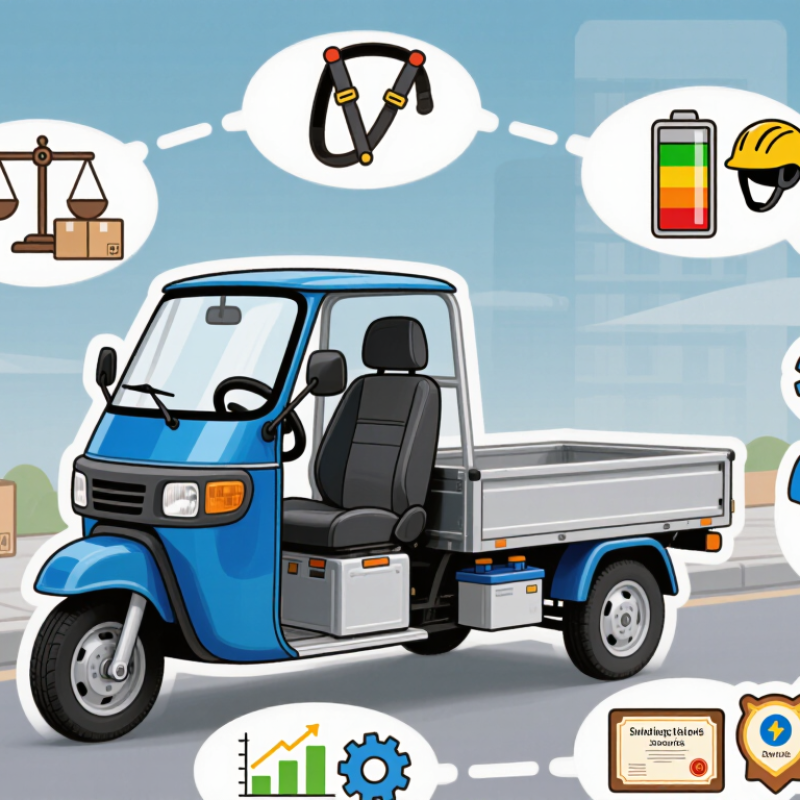
7 Tips for Buying an Electric Three Wheeler Cargo?

Define Your Cargo Needs and Daily Operating Conditions

Tip 1: Measure your real cargo before choosing an electric three wheeler. Record weight, length, height, and how often loads change. My first estimate was wrong because empty containers still occupied valuable space.

Tip 2: Study your daily route carefully. Note steep streets, narrow alleys, rough surfaces, traffic delays, and average distance. A vehicle that performs well on flat roads may lose range on repeated climbs. Tip 3: Match battery capacity to the full working cycle, not just one delivery. Include return trips, waiting time, lighting, and seasonal temperature changes. Keep a charging margin. It protects reliability.

Tip 4: Check the cargo bed’s usable dimensions and loading height. A low platform can reduce lifting injuries during busy shifts. Tip 5: Consider your actual payload, including tools, packaging, and occasional heavy items. Overloading can reduce braking performance and accelerate tire wear. It is an easy mistake. Tip 6: Test the vehicle on your real route, if possible. Pay attention to turning space, visibility, suspension movement, and driver comfort. Published specifications cannot show every operating condition. Tip 7: Plan daily charging and maintenance access. Inspect brakes, tires, lights, steering, and battery connections regularly. I would also record energy use for several weeks, then revise the original operating estimate. Some assumptions look precise until real work exposes them.

Compare Battery Range, Charging Time, and Power Requirements

Buying an electric three-wheeler cargo vehicle requires more than reading its advertised range. The International Energy Agency’s Global EV Outlook 2024 reports that electric models exceeded half of global three-wheeler sales in 2023. This growth makes battery comparison more important. Check usable battery capacity, not only the headline figure. A 5 kWh battery may travel 70 kilometers unloaded, but steep roads, heavy cargo, and frequent stops can reduce that distance sharply.

Charging time depends on both battery size and charger power. A 5 kWh pack connected to a 1 kW charger needs about five hours before charging losses. The U.S. Department of Energy’s Alternative Fuels Data Center explains that charging speed depends on battery capacity, charger output, and available electrical supply. Ask whether your warehouse has a suitable socket, stable voltage, and overnight charging access. A faster charger sounds useful, but it may require costly electrical upgrades.

Power requirements deserve practical testing. Compare continuous motor power, peak output, payload, and hill performance. Do not judge performance from motor watts alone. The Global Fuel Economy Initiative notes that real-world energy use varies with speed, load, and driving conditions. Request a loaded route test, ideally with the usual cargo weight. One overlooked detail can matter. A vehicle that reaches its range target only on flat, empty roads may fail during a busy delivery shift. Even careful calculations can be wrong, so leave a safety margin of at least 20 percent.

Evaluate Payload Capacity, Cargo Space, and Vehicle Dimensions

Tip 1: Check the rated payload, not the advertised carrying figure. Subtract passengers, batteries, tools, and safety equipment from that limit. A vehicle carrying 500 kilograms may have far less usable capacity. Tip 2: Spread the load evenly. Heavy items placed behind the rear axle can reduce steering control and increase stopping distance.

Tip 3: Measure the cargo bed’s length, width, and height. Then measure your actual boxes, bins, or containers. Wheel arches often steal valuable space. Tip 4: Look for a low loading height. It saves effort during repeated deliveries. Small details matter. Tip 5: Check the vehicle’s total dimensions, including mirrors and side rails. A narrow alley may still be difficult if the turning circle is wide.

Tip 6: Test the vehicle with a realistic load, if possible. Observe acceleration, braking, hill performance, and stability. A short empty test can be misleading. Tip 7: Confirm the axle ratings and suspension design. They reveal how safely weight can be carried over time. Do not rely on appearance alone. A large cargo box does not always mean a strong chassis. I would also measure your storage entrance before ordering; this basic step is easy to forget. Payload figures can vary by configuration, so request written specifications and compare them with your daily route.

7 Tips for Buying an Electric Three-Wheeler Cargo Vehicle: Evaluate Payload Capacity, Cargo Space, and Vehicle Dimensions

Tip What to Evaluate Useful Measurement or Benchmark Why It Matters Questions to Ask Before Buying
1Verify the Real Payload Check the maximum permissible payload, including the driver, passengers, cargo, batteries, and accessories where applicable. Typical light-duty range: 300–500 kg
Leave at least a 10–15% operating margin below the rated limit.
Regularly operating at the maximum rating can increase braking distance, tire wear, motor temperature, and battery consumption. Is the payload rating based on the complete vehicle? Does it include the battery and driver? Is the rating valid on slopes and uneven roads?
2Measure Usable Cargo Space Assess the internal length, width, height, floor area, and wheel-arch intrusion of the cargo box rather than relying only on the advertised volume. Common cargo-box volumes: approximately 1.5–3.5 m³
Confirm internal dimensions in millimetres.
A box may have sufficient volume but still fail to accommodate standard cartons, produce crates, tools, or equipment because of its shape. What are the clear internal dimensions? What is the distance between wheel arches? Can the tailgate or side panels be opened fully?
3Match Vehicle Dimensions to the Route Compare overall length, width, height, wheelbase, turning circle, and ground clearance with the roads, gates, loading bays, and parking areas used every day. Typical overall width: about 1.0–1.5 m
Typical ground clearance: about 120–180 mm
A compact vehicle is easier to manoeuvre in narrow streets, while greater clearance can reduce the risk of underbody contact on rough roads. Will it pass through the narrowest gate? Can it fit in the assigned parking space? What is the turning circle measured between kerbs?
4Check Range Under Working Conditions Evaluate battery capacity and practical loaded range, not only the laboratory or no-load range. Typical battery capacities: 8–20 kWh
Plan around 60–80% of the claimed range for payload, hills, traffic, weather, and accessory use.
Payload, speed, gradients, tire pressure, temperature, and frequent stops can materially reduce energy efficiency and daily range. What is the loaded range at the intended speed? How does range change on slopes? Is the battery removable, and what is its usable capacity?
5Review Charging Time and Electrical Safety Confirm the charger rating, charging connector, circuit requirements, battery management system, and protection against overcharge and overheating. Typical AC charging time: approximately 4–10 hours, depending on battery size and charger output. Charging must fit the operating schedule and the available electrical supply at the depot, shop, or home. What outlet and circuit capacity are required? Can charging be scheduled? Is there protection against over-temperature, over-current, and deep discharge?
6Evaluate Braking, Tires, and Stability Inspect the braking system, tire load rating, suspension, axle design, lighting, mirrors, seat belts, and load-restraint provisions. Look for brakes sized for the fully loaded gross vehicle weight and tires whose combined rated capacity exceeds the actual axle loads. Three-wheelers can have a different weight distribution from four-wheel vehicles. Secure cargo and smooth weight placement help maintain stability. Are hydraulic or mechanical brakes fitted? Is regenerative braking available? What is the maximum safe speed with a high or uneven load?
7Calculate Total Cost of Ownership Compare purchase price with energy, maintenance, battery replacement, insurance, registration, charging equipment, and downtime. Energy cost per trip = electricity used in kWh × local electricity price
Also request the battery warranty and expected service schedule.
A lower purchase price may be offset by limited range, slow charging, short battery coverage, expensive parts, or insufficient local service support. What is covered by the warranty? What is the expected battery service life? Are replacement tires, brake parts, chargers, and batteries readily available?

Check Safety Features, Build Quality, and Maintenance Support

7 Tips for Buying an Electric Three Wheeler Cargo

Safety should guide the purchase, not just the advertised payload. Look for hydraulic or regenerative braking, strong lights, reflectors, reverse alarms, and a reliable parking brake. The battery should include a certified management system, thermal protection, and a sealed enclosure. Check the stated IP rating, but do not trust it blindly. Real roads are dusty, wet, and uneven.

Build quality appears in small details. Inspect welds around the frame, axle mounts, and cargo bed. Uneven welds may signal rushed production. Confirm the payload rating with the battery installed, not only the empty vehicle. Test the suspension with a realistic load. The International Energy Agency reported about nine million electric two- and three-wheelers sold globally in 2023. That growth makes quality control more important, especially for daily commercial use. A shiny frame proves little.

Maintenance support can decide whether the vehicle earns money or sits idle. The U.S. Department of Energy’s Alternative Fuels Data Center notes that electric vehicles avoid oil changes and use fewer moving parts. However, tires, brakes, suspension, wiring, and batteries still need attention. Ask for service intervals, diagnostic procedures, spare-part availability, and battery warranty terms. Request the expected replacement cost. I would also ask how quickly a technician responds outside major cities. This is often overlooked. A short test ride cannot reveal every weakness, so inspect the vehicle again after carrying a full load.

Calculate Total Ownership Costs and Verify Legal Requirements

7 Tips for Buying an Electric Three Wheeler Cargo

Tip 1: Calculate total ownership costs before comparing purchase prices. Include charging, electricity, insurance, registration, maintenance, tires, battery replacement, and financing. Estimate daily distance, payload, terrain, and stop frequency. A vehicle climbing ramps with a full load may consume more energy than advertised.

Tip 2: Build a twelve-month cost sheet. Record expected trips, charging hours, electricity rates, service intervals, and downtime. My first estimate would likely miss small costs, such as brake adjustments or damaged cargo covers. Leave a realistic repair reserve. Cheap ownership is not guaranteed by a low purchase price.

Tip 3: Verify legal requirements before paying a deposit. Rules can differ by country, state, city, and road type. Confirm the vehicle’s classification, permitted speed, maximum dimensions, payload limit, lighting, mirrors, brakes, registration, insurance, and operator license requirements. Ask the relevant transport authority for written guidance, not only verbal sales advice.

Check whether the vehicle may enter commercial zones, restricted roads, pedestrian areas, or delivery centers. Some areas require special permits or safety equipment. Confirm charging installation rules too, especially for warehouses and shared parking spaces. Keep copies of certificates, invoices, inspections, and approvals.

A useful test is a supervised route with your normal cargo weight. Measure battery use, turning space, braking distance, and loading time. Then compare those results with your cost sheet. Real roads are less forgiving.

Back to top
