
Choosing the right Lenses For Glasses is not simply a matter of selecting the thinnest option. Your prescription, daily habits, face shape, and budget all influence the final decision. A university student who spends hours reading needs different lens features from a cyclist facing wind, dust, and changing light.
“Your eyeglass lenses should match your vision needs and your lifestyle,” says Dr. Gary Heiting, OD, an optometrist and long-time vision-care educator. This practical view keeps the process grounded in professional experience. An eye-care specialist can assess prescription strength, astigmatism, focusing difficulties, and potential eye-health concerns. Online measurements may appear convenient, but they cannot replace a complete eye examination.
Small details matter. High-index lenses can reduce thickness for stronger prescriptions. Polycarbonate lenses offer useful impact resistance for children and active adults. Anti-reflective coatings may reduce glare from computer screens and headlights. Photochromic lenses can darken outdoors, although they may not perform equally well inside every vehicle.
There is no universal winner.
This guide will compare lens materials, coatings, lens designs, and everyday use cases. It will also examine compromises that advertisements sometimes hide. I should acknowledge one limitation: comfort and visual clarity can vary between individuals, even with similar prescriptions. The “best” choice may still require adjustment after several days of wear. Reliable decisions come from combining an updated prescription, qualified professional advice, and honest attention to how your glasses are used.
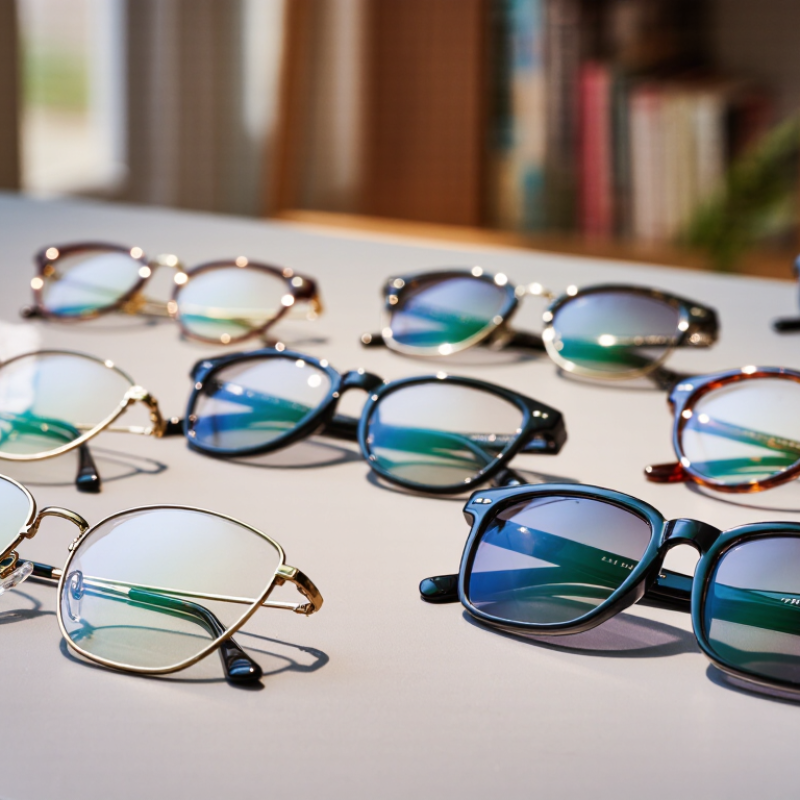
A suitable lens begins with an accurate prescription, not a fashionable coating or frame. An eye-care professional should check sphere, cylinder, axis, and pupillary distance carefully. Small measurement errors can cause blur, headaches, or eye strain. Your prescription also needs context. Do you read for hours, drive at night, or switch between screens and printed pages?
Visual priorities should guide the lens design. Someone working at a laptop may need comfortable intermediate vision, while a frequent driver may value sharp distance vision and reduced glare. Reading distance matters too. A book held 35 centimeters away creates different demands than a monitor positioned 65 centimeters away. Mention lighting conditions during your consultation. Dim rooms can expose problems that bright offices hide.
Frame size and lens position also affect performance. A large frame may require careful optical centering, especially for stronger prescriptions. Ask how the lenses will perform during daily movement, not only in a test chair. Adaptation can take time. Some choices may feel disappointing at first. That deserves review, not blind acceptance.
Bring your current glasses and describe specific difficulties, such as words swimming when you look down or street signs appearing soft after sunset. A reliable prescription is useful, but personal visual habits complete the decision.

Refractive index describes how strongly a lens bends light. Higher index usually means thinner lenses, especially for stronger prescriptions. A 1.50 lens suits low prescriptions and offers a high Abbe value, often around 58, for comfortable color clarity. The 1.56 option gives modest slimming, while 1.60 usually balances thickness, weight, and optical performance. Its Abbe value commonly sits near 40 to 42.
For stronger prescriptions, 1.67 and 1.74 can reduce edge thickness noticeably. Their typical Abbe values fall near 32 to 34, so some wearers may notice more chromatic blur at the sides. That effect depends on frame size, pupillary distance, and prescription power. Small, well-centered frames can outperform a higher index in daily comfort. Thin is not always better.
The World Health Organization’s 2023 World Report on Vision identifies uncorrected refractive error as a major global vision concern. Accurate refraction remains more important than cosmetic slimming. International lens standards, including ISO 8980-1, evaluate optical quality and durability, but they do not choose the best index for every face. In practice, an optician should compare prescription strength, frame dimensions, lens shape, and wearing habits. Polycarbonate may improve impact resistance, though its lower Abbe value can reduce visual clarity for sensitive users. I would not choose 1.74 automatically. The thinnest result can bring higher cost, stronger reflections, and less forgiving optics.
Lens material affects clarity, weight, thickness, and impact performance. CR-39 typically has an Abbe value near 58, while polycarbonate is about 30, according to optical material tables published by the Optical Laboratories Association. A higher Abbe value usually means less chromatic aberration. This may reduce colored edges around lights, screens, and high-contrast objects.
Polycarbonate remains practical for active lifestyles. It is lightweight and meets high-impact requirements under ANSI Z87.1 testing when properly manufactured and marked. However, its lower Abbe value can produce more noticeable color fringing, especially in strong prescriptions or larger frames. The Vision Council’s consumer research consistently identifies comfort, durability, and visual quality as major eyewear concerns. Still, one number cannot decide everything. Frame size, prescription strength, lens thickness, and fitting accuracy also matter. I have found that wearers often notice edge color only after changing materials. That surprise is worth discussing before ordering.
Tips: Ask an optician to compare both materials using your prescription. Choose CR-39 when optical clarity and cost matter most. Consider polycarbonate for children, sports, or frequent impact exposure. Check the final lens design, not only the material label. Abbe values are useful, but they are not perfect.
Choosing the right lenses begins with understanding how you use your eyes each day. Your prescription matters, but your viewing habits matter just as much.
Single-vision lenses correct one distance, such as reading, computer work, or driving. They suit people who need clear vision mainly for near or far tasks. If you switch between these distances often, separate glasses may feel inconvenient.
Bifocal lenses provide two prescriptions in one lens. A visible line divides distance vision from near vision, making the change easy to understand. However, images may appear to shift slightly when your eyes move between zones. Some wearers need time to adjust.
Progressive lenses offer a gradual change from distance to intermediate and near vision. They have no visible dividing line and can support many daily activities. The intermediate area helps with screens, while the lower section supports reading. These zones are narrower than many people expect. Accurate measurements, including pupillary distance and fitting height, are essential. An experienced eye-care professional should check how the frame sits on your face. A poor fit can make even well-designed lenses uncomfortable. I once underestimated this detail and blamed the lens design too quickly. The frame, posture, and viewing distance were part of the problem. Allow several days for adaptation, but report persistent dizziness, headaches, or blurred vision for a professional review.
Choosing lenses involves more than prescription strength or frame style. The Vision Council’s 2023 Consumer inSights report found that about 80% of U.S. adults wear sunglasses. That figure reflects strong demand for daily eye protection. UV400 lenses should block ultraviolet wavelengths through 400 nanometers. However, UV400 is a performance claim, not a complete safety standard. Ask for test documentation, especially when buying prescription sunglasses.
Anti-reflective, or AR, coating reduces glare from screens, headlights, and office lighting. It can improve night-time clarity, but it does not make lenses impact-resistant. AR surfaces may also show fingerprints more clearly. A careful fitting should include cleaning instructions and a check for coating defects under direct light. I would not choose AR alone.
For workshop, laboratory, or sports use, inspect the lens marking and packaging. ANSI/ISEA Z87.1-2020 covers impact-resistant eye and face protection, including testing and marking requirements. Basic and high-impact classifications are not interchangeable. The National Safety Council reported 36,840 occupational eye injuries involving days away from work in 2022. That number is a useful warning, although ordinary prescription glasses may not meet workplace protection requirements. Clear lenses can still filter UV. Darker lenses can feel safer, but darkness does not prove better protection. This is where many buyers, including experienced ones, may assume too much.
Lens specifications address different needs: AR reduces reflections, UV400 indicates ultraviolet protection up to 400 nm, and ANSI Z87.1 concerns impact-resistant eyewear performance.
The chart shows whether each specification directly addresses a protection or optical feature. A value of 1 means the feature is specifically included; 0 means the specification does not directly address that feature. ANSI Z87.1 is a safety standard, not a lens coating, and should be selected when impact protection is required.
For an immediate response, please call this
number08045801431
Price:
