
Choosing the right Submarine Hose is not a simple matter of matching diameter and length. It requires a clear understanding of the fluid, pressure, seabed conditions, movement, and connection system.
A hose handling crude oil may face different stresses from one carrying dredging slurry. Abrasive particles can wear the inner tube quickly. Tidal movement can twist the assembly. Floating sections may experience waves, current, and repeated bending near the shore connection. Small details matter.
Marine hose engineer Dr. John C. McGowan once said, “A hose should be selected for its entire operating environment, not one impressive specification.” That principle remains practical. A high-pressure rating alone does not guarantee safe service. Compatibility with oil, chemicals, temperature, vacuum, and bending radius must also be checked.
Look closely at the working site. Is the hose dragged across rough ground? Does it hang vertically between a vessel and a pipeline? Will maintenance crews inspect it underwater, or only during scheduled shutdowns? These questions change the design choice.
A reliable selection process also reviews flange standards, reinforcement layers, buoyancy, abrasion resistance, and emergency handling. Manufacturer data should be compared with actual operating conditions. Independent inspection records can reveal weaknesses that brochures often omit.
There is no perfect hose for every project. That is worth admitting. Engineers sometimes focus on pressure and overlook fatigue. Operators may choose a lower-cost model, then face expensive replacement work.
This guide explains how to evaluate each factor, avoid common selection mistakes, and choose a Submarine Hose that performs consistently in demanding marine service.
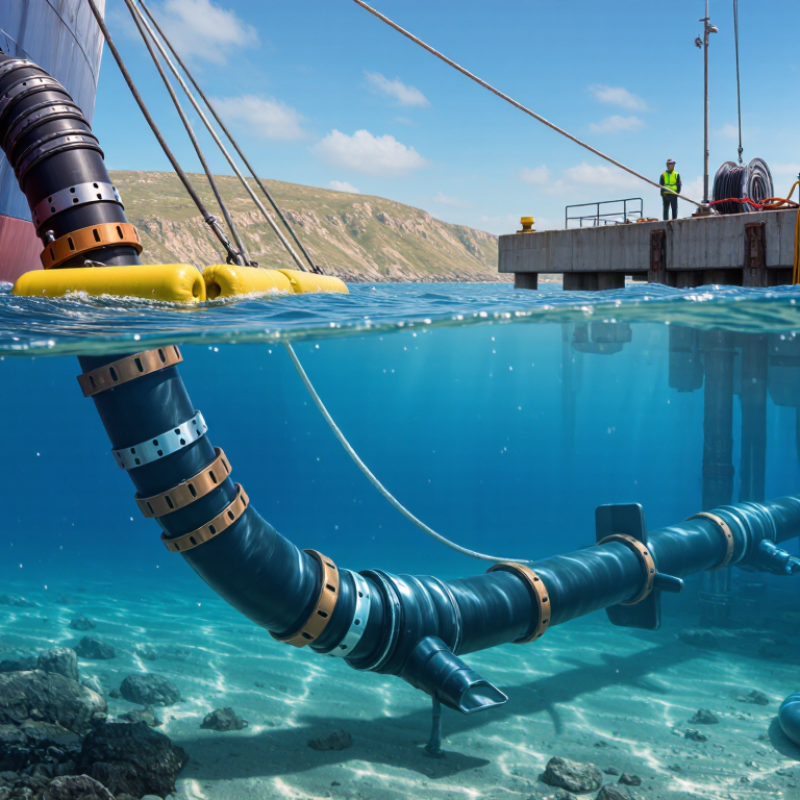
Choosing a submarine hose starts with its real duty, not its catalogue diameter. These hoses serve offshore loading, dredging, seawater intake, and floating production systems. UNCTAD’s Review of Maritime Transport 2024 reports that over 80% of global merchandise trade moves by sea. That scale keeps marine transfer infrastructure under constant pressure.
Define the operating envelope before selecting materials. Record working pressure, temperature, fluid density, chemical content, current speed, wave motion, and minimum bend radius. A hose exposed to crude oil needs different lining resistance than one carrying abrasive dredged slurry. Seawater also accelerates corrosion around flanges and reinforcement. API 17K and OCIMF guidance provide useful design and inspection references. Still, a standard cannot replace site data. It is an uncomfortable gap.
Dynamic movement deserves careful attention. Floating units can impose repeated bending, tension, torsion, and pressure cycles. Calculate fatigue life using actual motion records, not calm-weather assumptions. Check buoyancy, submerged weight, seabed contact, and anchor loads. Field inspections often find damage near couplings, where bending becomes concentrated. A sharp coral edge can defeat an otherwise strong hose. Small details matter.
IEA’s Oil 2024 report projects oil demand to reach about 105.4 million barrels per day by 2030. Existing offshore transfer assets may therefore face longer service periods. Specify abrasion resistance, bend restrictors, traceable testing, and inspection intervals. Document pressure tests and visual findings after installation. I would also challenge the assumed service life; it is often optimistic.

Choosing a submarine hose starts with service data, not catalog size. Record fluid type, temperature, pressure, flow rate, water depth, and connection movement. Crude oil, refined products, and biofuels can demand different lining materials. Chemical compatibility matters.
OCIMF’s GMPHOM 2009 guidance commonly uses 15 bar as a nominal working-pressure reference for offshore cargo hoses. Treat it as a baseline, not a final answer. Surge pressure can exceed steady pressure during valve closure. Select a hose with documented working pressure, burst pressure, and fatigue performance. The hose bore should support the required flow without creating excessive pressure loss. Check minimum bend radius under both installation and operating conditions. A tight bend near the tanker connection can become a hidden failure point.
Tips: Ask for verified test records. Review pressure, vacuum, tensile, bend, and electrical-continuity results. OCIMF’s SPM Hose System Integrity Assurance Guidelines also support risk-based inspection planning, rather than relying on one fixed interval. Inspect covers for cuts, blistering, exposed reinforcement, and unusual flattening. Measure movement during loading operations. Small changes matter.
Do not ignore buoyancy. A hose that floats higher than designed can overload end fittings or alter the catenary. IOGP guidance on offshore integrity management emphasizes traceable inspection data and clear acceptance criteria. In practice, records are sometimes incomplete. That is uncomfortable, but it should influence the specification. Require material certificates, factory test reports, installation limits, and a defined replacement threshold before purchase.
Choosing a submarine hose starts with the material, not the catalogue image. Rubber hoses handle abrasion, movement, and repeated bending well. Thermoplastic hoses are lighter and often resist oils or chemicals more consistently. However, material charts cannot predict every site condition. Seawater temperature, pressure pulses, sunlight, and sediment may change performance.
Construction matters just as much. A single-layer hose may suit low-pressure service, but reinforced designs offer greater strength under deep-water loads. Spiral wire, textile reinforcement, and multiple protective covers each affect flexibility and fatigue life. I have found that a very stiff hose can protect against collapse yet create difficult handling during installation. That trade-off is easy to overlook. Real measurements are better than assumptions.
Connection methods should match the hose movement and maintenance plan. Flanged ends provide secure alignment and familiar inspection points. Quick couplings reduce connection time, but they need careful locking checks and clean sealing surfaces. Swivel connections can reduce twisting when the hose moves with waves or current. Poor alignment remains a common failure source. Check it carefully. Before approval, verify pressure ratings, bend radius, gasket compatibility, and test records. Inspect reinforcement near the ends, where stress often concentrates. A documented inspection routine gives stronger evidence than confidence alone. Even experienced teams should review the choice after field trials, because actual seabed conditions can expose weaknesses that drawings miss.
A submarine hose must match the service, not just the connection size. Confirm the transported fluid, working pressure, temperature, depth, and flow rate. Check its resistance to abrasion, seawater, sunlight, and repeated bending. A hose that performs well on deck may fail under tidal movement.
Safety documentation deserves close attention. Select hoses tested against recognized marine standards and request certificates for pressure testing, material traceability, and electrical continuity when required. Verify the stated burst pressure and working pressure separately. They are not interchangeable. Ask for inspection records, installation guidance, and emergency procedures. A missing document is a warning sign.
Maintenance begins before installation. Measure the minimum bend radius and protect contact points from sharp structures. Inspect covers for cuts, swelling, exposed reinforcement, and unusual stiffness. Use scheduled pressure tests, visual checks, and accurate service records. Rotate or replace components according to actual operating conditions, not habit. Salt deposits can hide damage. Clean them carefully.
Do not trust appearance alone. A hose may look sound while its reinforcement is weakening internally. This is where practical judgment matters. Inspections can miss early fatigue, especially after storms or rough handling. When uncertainty remains, isolate the hose and obtain a qualified technical assessment. A cheaper hose can create higher maintenance costs later. Reliability is built through evidence, disciplined inspection, and honest review of past failures.
Choosing the best submarine hose starts with project conditions, not catalog size. Define the fluid, temperature, pressure, depth, flow rate, and transfer frequency. Seawater, abrasive slurry, and hydrocarbons require different tube materials and reinforcement. A hose rated for surface service may collapse under external pressure. Check the working pressure, test pressure, and minimum bend radius together. Never select these values separately.
UNCTAD’s Review of Maritime Transport 2024 states that over 80% of global merchandise trade by volume moves by sea. That exposure makes hose reliability a practical risk-control issue. For offshore projects, the Global Offshore Wind Report 2024 recorded 10.8 GW of new offshore wind capacity commissioned during 2023. These installations often involve long subsea routes, strong currents, and repeated motion. Therefore, evaluate fatigue cycles, buoyancy, seabed contact, abrasion, and connector loads. Small details matter. A protective cover can fail where the hose repeatedly touches a sharp frame.
Field reviews commonly reveal one weak assumption: “The hose is flexible, so it will tolerate movement.” Not always. Calculate dynamic loads from waves, vessel drift, and tidal currents. Confirm bend-stiffness data through independent testing, preferably under realistic temperature and pressure conditions. Require traceable certificates, dimensional checks, hydrostatic testing, and inspection intervals. ISO and industry guidance can define a baseline, but they cannot replace site-specific engineering. I would also review emergency release forces and spare-hose logistics before approval. The cheapest selection may become expensive after one preventable shutdown.
Water pressure increases by approximately 1 bar for every 10 metres of seawater depth. Use the expected installation depth to check the hose’s external pressure resistance, collapse resistance, reinforcement design, and required safety margin. Final hose selection should also consider working pressure, temperature, chemical compatibility, bend radius, buoyancy, and cyclic movement.
For an immediate response, please call this
number08045801431
Price:
