
Choosing the right dry type transformer begins with application details, not marketing labels. Voltage, load profile, altitude, ventilation, fire risk, and maintenance access can change the best choice.
The International Energy Agency’s Electricity Grids and Secure Energy Transitions report estimates that annual grid investment must exceed USD 600 billion by 2030. That pressure is increasing demand for compact, efficient, and safer transformer installations in buildings, factories, data centers, renewable projects, and transport systems. A dry type transformer avoids liquid insulation, reducing spill concerns and simplifying indoor placement. However, “safer” does not mean risk-free. Heat, dust, harmonics, and poor airflow still shorten insulation life.
This guide examines ten practical transformer types, including cast-resin, VPI, open-wound, air-core, iron-core, single-phase, three-phase, isolation, grounding, and furnace transformers. The classifications overlap. That matters. A three-phase unit may also use cast-resin insulation and serve as an isolation transformer. IEC 60076-11 provides the main international framework for dry-type transformer design and testing, while IEEE C57.12.01 supports North American practice. The U.S. Department of Energy’s distribution-transformer efficiency rules also show why losses deserve attention throughout the equipment’s service life. Small percentages become substantial costs.
No universal ranking exists. Site conditions decide performance. This article therefore compares construction, insulation behavior, cooling needs, noise, efficiency, protection, and typical uses. Some choices remain debatable, especially where price competes with long-term reliability. That uncertainty deserves attention.
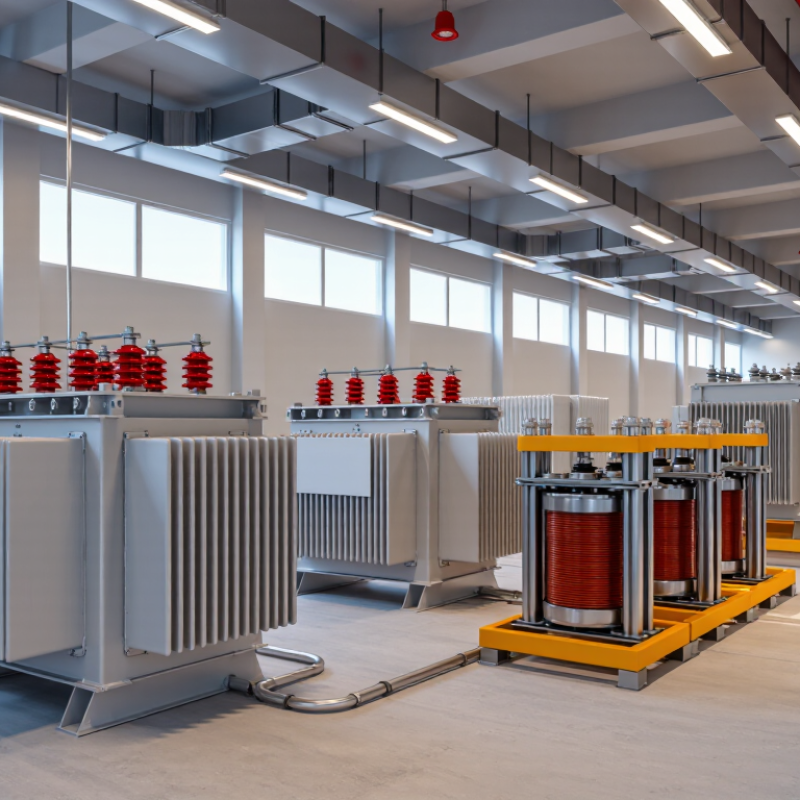
Dry-type transformers transfer electrical energy without liquid insulation. Their windings use air, resin, or solid insulation. IEC 60076-11 classifies them by insulation system, cooling method, and environmental conditions. The ten common types are air-core, open-wound, vacuum pressure impregnated, cast-resin, encapsulated, self-cooled, fan-cooled, indoor, outdoor, and traction transformers. These categories can overlap. The boundary is not always clean.
Air-core designs suit high-frequency or low-loss applications. Open-wound units offer ventilation but need controlled surroundings. VPI transformers use resin-treated insulation, while cast-resin units surround windings with hardened resin. The latter handles moisture better. Indoor and outdoor versions depend on enclosure, pollution level, and temperature exposure. Self-cooled units rely on natural air movement; fan-cooled models add forced airflow. Traction units require strong vibration and thermal performance.
Selection should begin with voltage, load profile, short-circuit strength, noise limits, and installation altitude. IEC 60076-11 also uses thermal classes and fire-performance criteria. The U.S. Department of Energy’s 2024 distribution-transformer rule highlights efficiency as a major lifecycle factor, not merely a purchase specification. A 2024 MarketsandMarkets report projects continued dry-type transformer growth through 2028, driven by safer indoor installations and grid expansion. Market forecasts vary. That uncertainty deserves attention. Field experience also shows that dust, loose connections, and poor airflow can erase expected efficiency gains.

What Are the Top 10 Types of Dry Type Transformers?
The Ten Main Types of Dry-Type Transformers are best understood by insulation, construction, phase, and application. Cast-resin transformers seal windings in epoxy, offering strong moisture resistance in hospitals and underground stations. VPI transformers use vacuum pressure impregnation, which improves insulation strength while keeping maintenance practical. Open-wound transformers rely on treated air-cooled windings and often serve cleaner indoor environments.
Air-core transformers avoid magnetic core losses and suit high-frequency or specialized systems. Iron-core transformers remain common for standard power distribution. Single-phase units support smaller buildings and control circuits. Three-phase transformers handle industrial loads more efficiently. Isolation transformers separate electrical circuits and reduce transferred electrical noise. Grounding transformers create a neutral point for systems that need earth-fault protection. Furnace and rectifier transformers serve demanding industrial loads with unusual current patterns.
According to the International Energy Agency’s Renewables 2024 report, global renewable capacity additions reached almost 510 GW in 2023. That rapid expansion increases demand for reliable transformers near solar and wind facilities. Industry reports from MarketsandMarkets also identify grid modernization and renewable integration as major dry-type transformer growth drivers. Selection still requires careful review of voltage, load profile, altitude, enclosure, and heat dissipation. Specifications can be misleading. A cast-resin unit may resist moisture well, yet poor ventilation can still shorten its service life. Engineers should verify tested temperature rise, acoustic performance, short-circuit strength, and applicable IEC or IEEE requirements before approval.
The chart compares representative power ratings commonly associated with major dry-type transformer construction and application categories. Actual ratings vary according to voltage, insulation system, cooling method, enclosure, and installation requirements.
Common dry-type transformer types include open-wound, VPI, cast-resin, encapsulated, air-core, single-phase, three-phase, isolation, grounding, and traction transformers. These categories can overlap; for example, a cast-resin unit can also be three-phase or used for isolation.
What Are the Top 10 Types of Dry Type Transformers?
Dry type transformers are grouped by construction, cooling method, winding design, and insulation system. Ten practical types include open-ventilated, cast-resin, VPI, encapsulated, foil-wound, copper-wound, aluminum-wound, single-phase, three-phase, and harmonic-mitigating transformers. These categories can overlap. A three-phase unit may also use cast resin and forced-air cooling.
Construction controls how heat moves through the transformer. Open-ventilated designs use air channels around exposed windings, so clean indoor rooms are essential. Cast-resin windings are sealed in solid insulation, reducing moisture penetration and maintenance needs. VPI windings use vacuum pressure impregnation, which strengthens insulation without fully enclosing the coils. Encapsulated designs offer stronger protection in dusty or humid areas.
Cooling systems commonly use natural air, called AN, or forced air, called AF. Natural cooling is quieter and simpler. Fans increase capacity but add noise, controls, and failure points. Insulation may include polyester varnish, epoxy resin, aramid materials, or laminated barriers. Temperature class matters because excessive heat shortens insulation life.
Winding material also affects losses, weight, and connection quality. Copper usually offers strong conductivity, while aluminum can reduce weight and cost. Harmonic-mitigating designs need careful thermal assessment in facilities with many electronic loads. A common mistake is selecting by rating alone. Installation height, ventilation, dust, humidity, and uneven loading can change real performance. No design wins every site.
| No. | Transformer Type | Core and Coil Construction | Cooling Method | Insulation System | Typical Applications | Main Characteristics |
|---|---|---|---|---|---|---|
| 1 | Open-Ventilated Dry Type Transformer | Laminated electrical-steel core with exposed windings mounted in a ventilated enclosure. | AN (air natural); AF (air forced) may be added for higher capacity. | Enamel-coated conductor insulation, insulation paper, polyester film, and class F or class H materials are commonly used. | Commercial buildings, industrial distribution, and indoor electrical rooms. | Cost-effective and easy to inspect, but requires a clean, dry, and adequately ventilated installation environment. |
| 2 | Vacuum Pressure Impregnated (VPI) Transformer | Windings are vacuum-impregnated with resin and cured to improve mechanical strength and moisture resistance. | Usually AN; AF cooling can be provided when additional thermal capacity is needed. | Thermosetting polyester or epoxy-based resin impregnation combined with high-temperature solid insulation. | Industrial plants, motor drives, renewable-energy systems, and variable-load installations. | Good resistance to vibration, thermal cycling, and moderate environmental contamination. |
| 3 | Cast-Resin Transformer | High-voltage windings are fully encapsulated in cured epoxy resin; low-voltage windings are commonly foil or layered conductors. | AN as standard; AF fans may be used to increase short-term or continuous rating. | Solid epoxy encapsulation with conductor enamel, glass, and other high-temperature insulation materials. | Hospitals, tunnels, high-rise buildings, transportation facilities, and humid or dusty locations. | Flame-retardant and low-maintenance design with strong moisture resistance; generally heavier than open-wound designs. |
| 4 | Encapsulated Non-Cast Dry Type Transformer | Windings are enclosed or partially encapsulated using resin, varnish, or a molded insulating compound rather than a full cast-resin block. | AN, with optional AF cooling for increased load capability. | Resin, varnish, polyester, mica, and other solid insulation systems selected for the required thermal class. | Light industrial facilities, commercial power distribution, and indoor substations. | Provides more environmental protection than a basic ventilated design while allowing different manufacturing approaches. |
| 5 | Non-Ventilated or Sealed Dry Type Transformer | Core and windings are enclosed in a sealed enclosure that limits the exchange of surrounding air. | Heat is transferred through the enclosure by natural convection; external heat exchangers or fans may be used in some designs. | Solid insulation, resin or varnish treatment, and sealed-enclosure protection. | Dusty, corrosive, high-humidity, or restricted-air environments. | Reduces contamination from the surrounding atmosphere, but heat dissipation and enclosure temperature must be carefully evaluated. |
| 6 | Air-Core Dry Type Transformer | Windings are arranged without a ferromagnetic core, eliminating core losses and saturation effects. | AN or AF, depending on power level and installation requirements. | Enamel, polyester, epoxy, fiberglass, mica, and other solid electrical insulation materials. | High-frequency equipment, current-limiting reactors, testing systems, and specialized power-electronic applications. | Suitable for high-frequency or specialized applications, but generally has higher magnetizing-current requirements than core-type designs. |
| 7 | Core-Form Dry Type Transformer | Windings surround separate limbs of a laminated core, with the magnetic circuit completed through the top and bottom yokes. | AN or AF, using natural air circulation or forced-air fans. | Layer, disc, foil, or continuous-disk windings insulated with enamel, paper, film, resin, and pressboard. | General-purpose distribution and industrial power conversion. | Widely used construction with accessible winding geometry and efficient use of magnetic material. |
| 8 | Shell-Form Dry Type Transformer | The magnetic core surrounds or encloses a substantial portion of the windings, creating a compact magnetic structure. | AN or AF, depending on the thermal design and rated capacity. | Layered or foil windings using enamel, film, paper, pressboard, resin, and other solid insulation materials. | Rectifier systems, industrial converters, traction equipment, and applications requiring strong mechanical support. | Compact and mechanically robust; winding access and cooling-channel design require careful engineering. |
| 9 | Amorphous-Core Dry Type Transformer | Uses thin amorphous-metal core material, typically formed into wound core sections, with conventional low- or high-voltage windings. | Primarily AN; AF can be specified for suitable designs. | The insulation may be open-wound, VPI, or cast-resin; the amorphous core is a magnetic-material distinction, not an insulation system. | Energy-efficient building distribution and installations with long periods of low or no load. | Very low no-load losses are possible, although the core can be more sensitive to mechanical stress and may increase manufacturing complexity. |
| 10 | High-Temperature Dry Type Transformer | Core and windings are designed with thermally robust materials and clearances to operate at elevated temperature limits. | AN or AF; forced air is often selected where compact size or overload capability is important. | Class H or other high-temperature systems using suitable enamel, mica, fiberglass, resin, and insulating films. | Steel mills, data centers, renewable-energy plants, traction systems, and high-load industrial facilities. | Handles demanding thermal conditions when properly specified; actual loading still depends on ambient temperature, ventilation, and temperature-rise limits. |
Note: These categories can overlap. For example, a transformer may be simultaneously three-phase, core-form, VPI-insulated, and air-natural cooled. Cooling designations commonly include AN (air natural) and AF (air forced).
Performance comparisons become clearer when the ten common types are viewed by construction and application. The group includes air-core, iron-core, single-phase, three-phase, cast resin, VPI, open-wound, isolation, autotransformer, and grounding transformers. These categories overlap, so the comparison is not perfectly uniform. That is worth acknowledging.
Air-core units avoid core losses and perform well at higher frequencies, but they usually need more space. Iron-core designs provide stronger magnetic coupling and better efficiency for standard power distribution. Single-phase models suit small loads, while three-phase units handle industrial systems with better power balance. Cast resin transformers resist moisture, dust, and chemical exposure. They are reliable indoors and in harsh service areas. VPI units often offer lower weight and practical heat dissipation, although their protection depends more heavily on the enclosure and installation environment.
Open-wound transformers can be economical in clean, controlled rooms. Isolation transformers reduce electrical noise and separate circuits, but they do not automatically improve efficiency. Autotransformers are compact and efficient, yet they lack full electrical separation. Grounding transformers support system protection and fault management rather than ordinary load conversion. In field inspections, temperature rise, sound level, winding losses, insulation condition, and ventilation often matter more than the product label. A technically superior design can still underperform when airflow is restricted. Small details matter. Engineers should verify loading, harmonic content, altitude, and maintenance access before selecting a type.
What Are the Top 10 Types of Dry Type Transformers?
Dry type transformers differ by construction, cooling method, and intended load. Air-core transformers suit high-frequency circuits where magnetic coupling matters more than low voltage regulation. Laminated-core transformers support general industrial distribution and control panels. Toroidal transformers fit compact equipment because their circular cores reduce leakage and audible hum. Open-wound transformers work well in clean, dry indoor rooms, but they need protection from dust and moisture.
Cast-resin transformers are practical for hospitals, commercial buildings, and humid industrial areas. Their sealed windings resist moisture, though heat dissipation must be checked carefully. Encapsulated transformers suit dusty locations and small control systems. VPI transformers serve factories and utility rooms where strong insulation and repairable construction are valuable. Single-phase units fit lighting, residential, and small machinery loads. Three-phase units are better for motors, production lines, and balanced building distribution. Dry-type autotransformers can reduce voltage efficiently when electrical isolation is not required.
Selection should begin with voltage, kVA rating, frequency, duty cycle, and available space. Then examine temperature rise, noise limits, enclosure rating, altitude, and ventilation. A three-phase design may be efficient, yet poor phase balance can create unnecessary heating. A cast-resin unit may appear safer, but its weight and replacement access can complicate installation. I have seen neat catalog choices fail after site conditions were overlooked. Verify clearances, harmonic content, fault levels, and applicable electrical standards with qualified engineers. Field measurements matter.
For an immediate response, please call this
number08045801431
Price:
