China Top Keyless Entry Door Lock Suppliers
China has become a major manufacturing base for smart access hardware and residential security products. This guide explores China Top Keyless Entry Door Lock Suppliers through practical, evidence-based criteria. It focuses on factory capability, product quality, customization, and service reliability.
A dependable supplier should explain how each Keyless Entry Door Lock is tested before shipment. Important checks include battery endurance, fingerprint accuracy, keypad response, mechanical override, and resistance to moisture. Factory audits, product certifications, and traceable quality records also matter. They provide stronger evidence than attractive catalog photographs.
Look beyond the sales pitch.
Experienced buyers should request samples and test them on real doors. A lock may perform well in a showroom but fail after repeated outdoor use. Ask about installation tolerances, mobile app stability, firmware updates, and replacement parts. Clear answers often reveal a supplier’s technical depth. Vague promises deserve caution.
This overview also considers OEM and ODM support, production capacity, packaging quality, and communication during mass orders. Suppliers with in-house engineering teams can usually solve fit and integration problems faster. However, no manufacturer is perfect. Even established factories may have inconsistent batches or delayed responses. That possibility should remain visible.
The most reliable selection process combines factory visits, independent inspection, sample testing, and written specifications. It also compares warranty terms and after-sales responsibility. These details help importers, distributors, contractors, and property developers make safer purchasing decisions. The goal is not to identify the cheapest option. It is to find a capable partner that delivers secure, user-friendly, and durable access solutions.
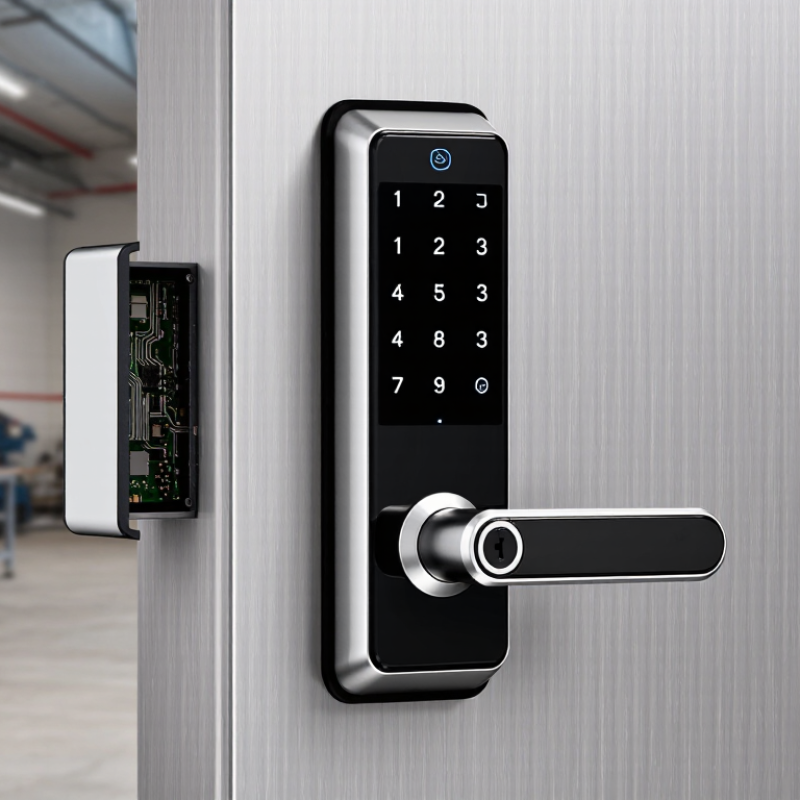
What Defines Keyless Entry Door Locks: ANSI/BHMA Grades and Main Technologies
China Top Keyless Entry Door Lock Suppliers
Keyless entry door locks replace traditional keys with PINs, cards, mobile credentials, or biometric recognition. Their real quality depends on more than attractive screens and wireless features. ANSI/BHMA grades provide a practical reference for durability, cycle testing, latch strength, and operational reliability. Grade 1 offers the highest performance level, while Grade 2 suits many commercial and residential applications. Grade 3 generally targets lighter residential use. However, a grade usually evaluates the lock hardware, not every digital function.
Main technologies create different user experiences. Keypad locks work without phones, but users must protect their codes. Bluetooth models support nearby mobile access and often consume less power. Wi-Fi models enable remote management, though they require stronger network security and stable connectivity. Biometric systems respond quickly, but wet or dirty fingers may reduce recognition accuracy. A reliable supplier should provide test documentation, battery warnings, mechanical override options, and clear installation instructions. Small details matter. A few millimeters of door misalignment can cause repeated locking failures.
Tips: Check the ANSI/BHMA grade, not just the product description. Ask for test reports and operating-temperature data. Confirm whether the lock supports your door thickness and backset. Review battery life under real usage, not only laboratory conditions. A high grade is valuable, but it cannot correct poor installation. That point is easy to overlook. A careful comparison should balance security, convenience, maintenance, and after-sales technical support.
China Top Keyless Entry Door Lock Suppliers: What Defines Keyless Entry Door Locks?
ANSI/BHMA grades classify lock performance and durability, while keyless technologies define how users authenticate and manage access.
The chart compares the standard cycle-endurance benchmarks commonly associated with ANSI/BHMA lock grades. A higher grade indicates a higher tested durability requirement; it does not identify a supplier or brand.
Keypad Entry
Users enter a PIN instead of carrying a traditional key. Access codes can often be changed or deleted.
RFID or NFC
Contactless credentials, cards, tags, or compatible mobile devices authenticate access through short-range radio communication.
Bluetooth
A smartphone can communicate locally with the lock, typically enabling app-based unlocking and digital key management.
Wi-Fi and Biometrics
Wi-Fi supports remote connectivity when designed for it, while fingerprint readers use biometric authentication. Actual features depend on the model.
China’s Smart Lock Market: 2023 Sales Data and Industry Growth Indicators
China’s smart lock market showed strong momentum in 2023, supported by rising apartment renovations, hotel upgrades, and connected-home demand. Sales data from industry reports indicated continued growth, although figures differed by research method and product category. Keyless entry models gained attention because they reduce dependency on metal keys and offer faster access through fingerprints, passwords, cards, or mobile control.
Chinese suppliers also expanded their export capabilities during this period. Many manufacturers improved testing procedures, battery monitoring, emergency power options, and software security. These details matter more than a polished product photo. A reliable supplier should explain failure rates, lock-cylinder standards, warranty terms, and after-sales response times. Market growth was real, but not every sales increase proved lasting demand. Some low-cost products received strong initial orders and weak repeat performance. That deserves careful review.
Tips: Ask for recent sales records, sample testing, and clear certification documents. Compare battery life under daily use, not laboratory claims. Check whether the supplier supports firmware updates and replacement parts. I would also test the lock during weak Wi-Fi or a dead phone battery. Small failures become serious at the front door. Supplier directories can help, but independent factory audits and customer references remain more reliable. Availability is not the same as quality.
How to Evaluate China Suppliers: MOQ, OEM Capacity, CE, FCC, and ISO 9001
China Top Keyless Entry Door Lock Suppliers
China’s keyless entry market is expanding with connected-home demand. MarketsandMarkets estimates the global smart lock market will grow from about USD 2.2 billion in 2023 to USD 4.4 billion by 2028. This growth increases supplier choices, but also increases verification risks. Start with MOQ. Ask whether the quoted MOQ applies to one model, finish, or firmware version. A low MOQ may hide higher tooling, packaging, or development costs. Review sample quality, battery access, keypad response, and emergency power details. A supplier’s OEM capacity should include mold ownership, firmware customization, app integration, and stable pilot production.
CE and FCC documents require careful checking. CE supports conformity with applicable European requirements; it is not a universal quality certificate. FCC approval concerns relevant radio-frequency emissions in the United States. Request test reports matching the exact model, wireless module, and electrical design. ISO 9001 shows that a quality-management system has been certified, not that every lock is reliable. TÜV Rheinland’s ISO Survey reported more than one million ISO 9001 certificates worldwide in 2022, yet certification alone cannot replace a factory audit. This distinction is easy to miss.
Tips: Compare three samples from separate production batches. Inspect screw alignment, latch movement, and standby power. Ask for corrective-action records, not only certificates. Check the certification body and report number independently. One weakness remains: many buyers judge suppliers from polished samples. That can be misleading. A pre-shipment inspection and a small pilot order provide stronger evidence than promises.
Top China Keyless Entry Lock Suppliers Ranked by Certifications and Production Scale
China’s keyless entry lock sector is expanding with stronger factory controls and export documentation. MarketsandMarkets estimates the global smart lock market will reach about USD 4.4 billion by 2029. This growth increases supplier competition, but certification quality still separates capable factories from attractive catalogs.
A practical ranking should place suppliers with ISO 9001 quality systems and audited production records in the highest tier. ISO 14001 adds evidence of environmental management. CE, RoHS, FCC, and regional radio approvals support safer international sales, while ANSI/BHMA or equivalent testing strengthens mechanical credibility. Production scale also matters. Review monthly output, automated assembly, aging tests, battery testing, and traceable serial numbers. A factory producing 50,000 locks monthly may outperform a larger site with weak inspection records. Certification count alone is not perfection.
Tips: Ask for current certificates, issuing-body details, test reports, and factory audit dates. Request a live production video, not only polished photos. Compare rejected-unit rates and warranty data across twelve months. The Fortune Business Insights report valued the global smart lock market at approximately USD 2.69 billion in 2023, showing why reliable capacity matters. Still, published market figures use different definitions. That is an inconvenient detail, but buyers should check each report’s scope before ranking China suppliers. A small pilot order can expose packaging failures, fingerprint errors, or unstable app connections before volume purchasing.
China Top Keyless Entry Door Lock Suppliers - Top China Keyless Entry Lock Suppliers Ranked by Certifications and Production Scale
| Rank | Supplier Profile | Estimated Monthly Production Scale | Relevant Certifications and Compliance | Keyless Entry Product Coverage | Typical Export Regions | Documentation Status |
| 1 | Supplier Profile A | 50,000–100,000 units | ISO 9001 CE FCC RoHS REACH | Fingerprint locks, PIN-code locks, RFID hotel locks, Bluetooth and Wi-Fi gateway solutions | North America, Europe, Southeast Asia, Middle East | High
Factory audit and certification files commonly available for buyer review |
| 2 | Supplier Profile B | 30,000–60,000 units | ISO 9001 CE FCC RoHS | Smart lever locks, deadbolt locks, keypad cylinders, apartment access-control products | Europe, North America, Australia, Latin America | High
Product test reports and quality-management records normally supplied during qualification |
| 3 | Supplier Profile C | 20,000–50,000 units | ISO 9001 CE RoHS REACH | Fingerprint door locks, keypad door locks, mortise locks, residential smart-lock accessories | Southeast Asia, Europe, Middle East, Africa | Moderate to High
Certification scope should be matched to each product model |
| 4 | Supplier Profile D | 10,000–30,000 units | ISO 9001 CE FCC Bluetooth Qualification | Bluetooth locks, mobile-app locks, hotel access systems, electronic cabinet locks | Europe, North America, Japan, South Korea | Moderate
Wireless approvals and regional frequency requirements require product-specific confirmation |
| 5 | Supplier Profile E | 8,000–20,000 units | ISO 9001 CE RoHS | Keypad locks, mechanical override locks, rental-property locks, basic electronic handles | Southeast Asia, Africa, Latin America, Middle East | Moderate
Confirm factory ownership, production capacity and current certificate validity before ordering |
| 6 | Supplier Profile F | 5,000–15,000 units | ISO 9001 CE RoHS | Fingerprint padlocks, compact cabinet locks, smart boxes, small-batch OEM products | Europe, Southeast Asia, Australia, Latin America | Moderate
Suitable for customized orders; independent pre-shipment inspection is recommended |
Comparison criteria include documented management systems, applicable product compliance, manufacturing scale, product range and export capability. Certification validity, scope, factory capacity and wireless approvals should be independently verified for the specific supplier and model before purchase.
Sourcing Checklist: IP Ratings, Battery Life, App Security, Warranty, and Lead Time
China Top Keyless Entry Door Lock Suppliers
When sourcing from China’s top keyless entry door lock suppliers, inspect IP ratings carefully. An IP65 rating may suit a covered exterior door, but exposed entrances need stronger weather protection. Ask for test conditions, not just certificates. Battery claims also require practical testing. Compare alkaline and rechargeable options under daily unlocking, Wi-Fi use, and cold temperatures. A lock promising twelve months may perform differently in a busy apartment.
App security deserves equal attention. Request details about encryption, multi-factor authentication, permission controls, audit logs, and software update procedures. Check where user data is stored and how access is removed after staff changes. Warranty terms should cover motors, circuit boards, keypads, and replacement parts. Confirm whether remote troubleshooting is included. Lead time must include sampling, customization, production, inspection, and shipping. A short factory estimate can hide several weeks.
Tips: Test at least two samples for thirty days. Record battery levels weekly. Ask for a written failure-rate policy and spare-parts list. Review the mobile app on different phones. I once trusted a polished specification sheet, but the prototype battery drained quickly in weak-signal areas. That mistake showed me that supplier promises need real-door testing, not just paperwork.




 Send Inquiry

